
Name: Batdorj Davaasuren
Affiliation: Research Unit for Advanced Preventive Medicine
Position: Foreign Visiting Researcher
Term: May 2026 – October 2026
Host researcher: Prof. Noboru Inoue (English /Japanese)
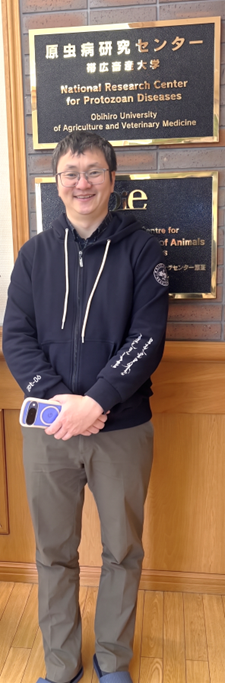
Circumstances of application:
I applied for the visiting researcher position at NRCPD to advance our joint project on dourine. Having previously studied as a PhD student at this institute, I have a deep appreciation for its exceptional research environment and already had firsthand experience with its advanced technical and theoretical resources. Returning to NRCPD felt like a natural choice. Following discussions with my host researcher, Professor Noboru Inoue, we identified this familiar and highly supportive facility as the ideal place to execute our specific research objectives. The opportunity to return and once again collaborate closely with the institute’s esteemed professors, postdoctoral fellows, and other researchers provided invaluable supervision and fostered a highly productive scientific exchange.
Research activity in NRCPD:
To safely preserve valuable equine genetics without transmitting Dourine via artificial insemination, semen must be completely cleared of T. equiperdum. A critical prerequisite for evaluating semen filtration efficacy is distinguishing viable, infectious trypanosomes from dead parasites. Because conventional PCR amplifies stable genomic DNA—yielding false-positives from dead cells—we developed a Spliced Leader (SL)-based RT-PCR assay targeting short-lived mRNA.
To simulate cooled semen transport, we evaluated parasite survival kinetics at 4°C across three media. In raw stallion semen, both T. equiperdum and T. evansi lost motility within 5 hours. However, semen extender provided nutritional and osmotic support that prolonged T. equiperdum survival up to 56–60 hours.
Crucially, we discovered that 4°C storage suppresses endogenous RNase activity, artificially preserving mRNA in dead cells. To resolve this for future post-filtration validation, we established that a brief 37°C incubation is required to reactivate RNases and degrade residual dead-cell mRNA.
In addition to my laboratory work, I actively participated in several valuable seminars and lectures hosted at the institute. The majority of these sessions focused on modern advancements in protozoan disease research. Attending these academic events provided an excellent opportunity to broaden my knowledge and exchange scientific perspectives with other dedicated researchers, professors, and students.
Future prospects:
We will continue our collaborative research on dourine, utilizing the results achieved at NRCPD as a foundational step for the next phase of our project. Once we finalize the RT-PCR methodology for accurately differentiating live from dead parasites, we will proceed to optimize the physical filtration steps for stallion semen. Beyond this specific project, I intend to continue my work on dourine and explore other scientific topics in ongoing partnership with NRCPD.